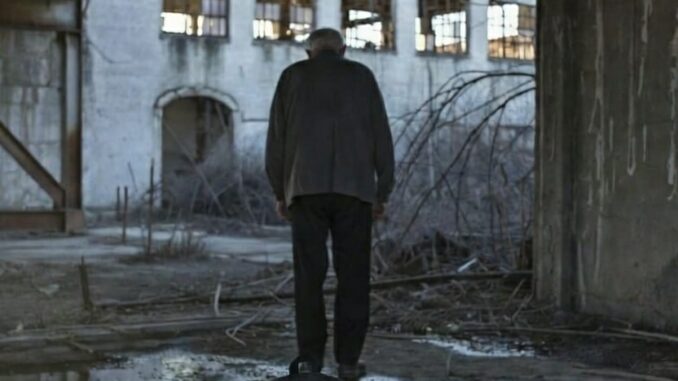
I’m seventy-two. Most mornings, well before dawn, I’m slipping backpacks under bridges.
Last week, one of them left me on my knees.
I parked my battered sedan behind the derelict textile mill—its shattered windows gaping like a broken grin. The air hung heavy with wet concrete and old beer. My knees protested as I eased down the embankment, but complaints don’t stop the work.
I’m not there to preach or pry.
I’m there to leave something simple.
A worn Jansport, wedged behind a rusted beam.
No tracts. No advice. Just necessities: thick wool socks, a toothbrush, a protein bar, a $20 gift card to the all-night burger joint, a small flashlight.
And a spiral notebook with a Sharpie taped to the cover.
The first page always carries the same words, in my careful hand:
*You don’t have to talk to anyone. Just talk to the paper. You are still part of this story.*
My name is Harris. I taught high school history for forty years.
Retirement promised museums, national parks, train rides with my wife, Martha.
But Martha slipped away soon after I closed my classroom door. The house turned hollow—the silence so thick it roared.
I started driving aimless circles through town.
That’s when I really saw them.
Not the polished kids in letterman jackets.
The invisible ones.
Teens in hoodies even in summer, hiding marks. Sleeping in cars behind the superstore. Huddled under overpasses for the only roof left.
Some I’d taught.
I’d watched them slide to the back row, then vanish—one empty desk at a time.
Years too late, I understood: shame screams louder than any bell. It whispers *you don’t belong* until they believe it and fade.
So I answered in silence.
I began leaving the packs.
At first, fear gnawed at me—fear of being seen, questioned, dismissed as a fool.
But the bags kept disappearing.
Often the notebooks stayed behind, pages crowded with words that could shatter stone.
“My stepdad changed the locks again. Freezing tonight. Thank you for the socks.”
“Three days without real food. I’m sobbing over a cheeseburger. Thank you.”
Then came last Tuesday.
I approached the spot by the old rail line. The backpack was gone.
A single folded sheet lay pinned beneath a stone.
My fingers shook as I opened it in the thin gray light.
It read:
*Mr. Stranger,*
*I had a plan tonight. A rope. I came here so no one would find me.*
*Then I tripped over your bag.*
*I ate the bar. Pulled on the socks. Read your line.*
*“You are still part of this story.”*
*I sat three hours. Cried until my chest hurt. But I didn’t use the rope.*
*I’m heading to the downtown shelter. Trying one more day.*
*You saved me. I don’t know your name, but you saved me.*
I sank to the dirt and cried—for the first time since Martha, not from loneliness, but from connection.
People urge me to go public: partner with charities, launch a foundation, chase headlines.
I always refuse.
Kindness shouted from rooftops can frighten the very people it seeks. Clipboards and questions make them bolt. Names become lies.
But a backpack found in the dark? That arrives like a whisper from somewhere kinder: *I see you.*
Yesterday I stepped onto the porch for the paper.
A backpack rested on the mat.
Heart pounding, I carried it inside and unzipped it.
One crisp apple. A pair of work gloves. A note in rushed, tilting script.
*Got my first paycheck washing dishes. Bought these myself. Pass them forward. Tell the next one they can make it through the night. I did.*
I stood in the hallway cradling that apple like treasure.
In a world obsessed with division—politics, screens, endless shouting—none of it reaches the cold under a bridge at 4 a.m.
No debates when you’re shivering. No factions when hunger claws.
Only darkness.
And the choice to leave a small, steady light.
You don’t need riches or power.
Just the courage to place something gentle where a hard life might fall.
Leave the light on.
Because someone out there is still looking for home.
Leave a Reply