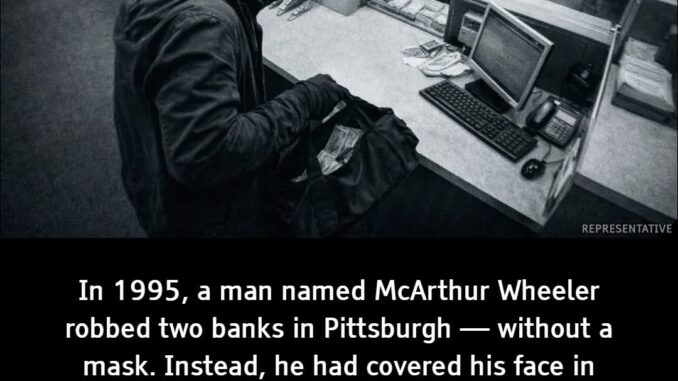
In 1995, a 44-year-old man named McArthur Wheeler walked calmly into two banks in Pittsburgh in the middle of the day and robbed them — without wearing a mask, without attempting a disguise, and without showing any urgency. He didn’t hide his face. He didn’t even try. Surveillance cameras captured him clearly, his features visible from every angle. It seemed like one of the most careless crimes imaginable.
But what truly stunned investigators wasn’t the robbery itself — it was his explanation.
Wheeler genuinely believed he had found a way to become invisible.
Before entering the banks, he had covered his face with lemon juice. His reasoning sounded almost childlike in its simplicity: lemon juice can be used as invisible ink, so if it can hide writing from the human eye, it could surely hide his face from security cameras. In his mind, he had discovered a loophole in reality itself.
Hours later, police identified him easily using the surveillance footage and arrested him. When officers showed him the clear video recording of his face, Wheeler was reportedly shocked. Confused and betrayed by his own logic, he said, “But I wore the juice.”
That single sentence would go on to echo far beyond the walls of a police station.
The bizarre case caught the attention of two psychologists, David Dunning and Justin Kruger. They weren’t just intrigued by the absurdity of the crime — they were fascinated by Wheeler’s unwavering confidence. How could someone be so wrong, yet so certain?
Their curiosity led them to conduct a series of studies examining a powerful cognitive bias. What they discovered became known as the Dunning–Kruger effect — the psychological phenomenon in which people with low ability or knowledge in a particular area tend to dramatically overestimate their competence. Even more striking, they often lack the self-awareness needed to recognize their own limitations.
In other words, the very skills required to perform well are often the same skills required to evaluate performance accurately. When those skills are missing, confidence can inflate unchecked.
Wheeler didn’t see himself as foolish. In his mind, he was clever. Innovative. Outsmarting technology. He wasn’t acting recklessly — he believed he had solved the problem.
And that is what makes the story both tragic and deeply human.
His case became one of the most cited real-world examples in psychology textbooks and academic discussions. What began as a strange bank robbery evolved into a lasting lesson about human perception and misplaced certainty.
We often assume ignorance feels like doubt. But sometimes, ignorance feels like confidence.
The story of McArthur Wheeler reminds us of something uncomfortable yet universal: the less we know, the more certain we may feel. True knowledge, on the other hand, often brings humility. The more we learn, the more we realize how much we don’t understand.
And somewhere between arrogance and awareness lies wisdom — the quiet understanding that we might not know as much as we think.
Sometimes, the most dangerous blindness isn’t physical invisibility.
It’s the inability to see our own limits.
Leave a Reply