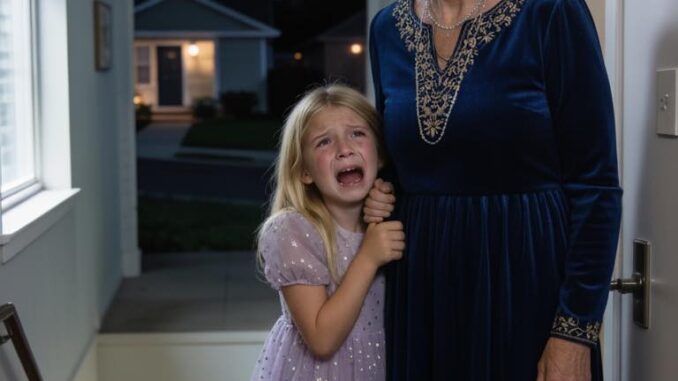
My stomach dropped. I lived alone on a quiet cul-de-sac outside Cleveland. No one showed up at my door that late unless something had gone terribly wrong.
I opened it slightly, the chain still fastened.
“Ms. Elaine Whitaker?” the man asked.
“Yes.”
He flashed his badge. “Detective Nolan Pierce. We need to talk.”
The phrase “need to” drained the warmth from my body. I removed the chain and let them in.
The detective studied me carefully, as if weighing how much to reveal at once. “Ma’am, your grandson was discovered chained in a basement.”
The world seemed to tilt. Rain hammered against the gutters. Somewhere down the street, a dog barked once and fell silent.
“That’s not possible,” I heard myself whisper. “I don’t have a grandson. I don’t have any grandchildren.”
His expression shifted instantly, tight and startled. “What did you just say?”
“I’ve never had children,” I repeated, slower this time. “Not one.”
The officers exchanged a glance. Detective Pierce didn’t look away. His eyes searched my face, as though the truth might be written there.
“You’re Elaine Marie Whitaker,” he said, opening the folder. “Born April 12, 1966. Formerly of Kenton Avenue. Retired nurse.”
My throat felt like sandpaper. “Yes.”
He turned the folder toward me. A printed photo was clipped inside: a boy with bruised wrists, dark hair tangled around a pale, exhausted face. His eyes were wide with something beyond fear. Beneath the image was an address.
My address.
“This child,” the detective said carefully, “was found tonight in a basement two miles from here. He told us his grandmother’s name is Elaine. He recited this address from memory. He said you’re the only one who would believe him.”
My hands began to tremble. “I’ve never seen him before.”
Pierce studied me for a long moment. “Have you ever been pregnant?”
“No.”
“Given a child up for adoption?”
“No.”
“Fostered?”
“No,” I said, my voice breaking. “I was engaged once. That’s all.”
His jaw tightened. Then he asked, more gently but with greater weight, “Do you have a sister?”
The rain grew louder in my ears. “I… I had one.”
“Had?”
“She died. Years ago.”
“What was her name?”
The name caught in my throat. Saying it felt like reopening a sealed wound. “Marianne.”
The detective’s shoulders stiffened. He glanced down at the folder again, then back at me—no longer just concerned, but alarmed.
“Ms. Whitaker,” he said quietly, “we need to come inside.”
I stepped aside, heart hammering.
Because suddenly I understood what he hadn’t yet spoken aloud:
If I never had children…
Why did a chained boy know my name?
And why was my address already printed in a police file?
They hadn’t knocked on the wrong door.
Someone had been telling a story—using me as part of it.
In my living room, Detective Pierce sat across from me with a legal pad while one officer remained by the door. The other, Officer Reyes, stood calmly with her hands folded, her eyes scanning the room as if expecting another presence to materialize.
“The boy’s name is Connor Hale,” Pierce said. “He’s eight. We found him in a locked basement storage room. He had a chain around his ankle. He’s at the hospital now.”
The word ankle made my stomach twist. “Who did that to him?”
“We’re investigating,” Pierce replied. “But Connor gave us names. Places. And he kept repeating one thing: ‘My Grandma Elaine will know what to do.’”
I swallowed hard. “I’m not his grandmother.”
“I believe you,” he said softly—and I could tell he did. My reaction wasn’t guilt. It was genuine shock. “But we need to understand why he thinks you are.”
Officer Reyes stepped closer. “Connor said his mother told him never to trust anyone except Grandma Elaine.”
“His mother?” I asked faintly.
Pierce nodded. “He says her name is Mari.”
The air left the room.
Because only one person had ever shortened Marianne to Mari.
No one outside our family ever called my sister Mari. It was always Marianne—except to us. Mari had disappeared from my life in a way I could never properly explain without sounding unstable.
“My sister is dead,” I said—but it sounded uncertain, even to me.
Detective Pierce didn’t challenge me. He opened the folder and slid a photocopied document across the table. “We recovered this from the house where Connor was being held,” he said. “It’s a copy of a birth certificate. The mother listed is Marianne Whitaker.”
My vision swam. “That’s impossible.”
Pierce leaned forward, voice controlled. “Were you ever present for her death? Did you identify her body?”
I opened my mouth, then stopped.
No. I hadn’t.
I’d been told she overdosed in Florida. That there was nothing left to see. That viewing her would only traumatize me. The call came from an unfamiliar number—a man claiming to be her landlord. He sounded official. Compassionate.
I believed him. I mourned her.
“I never saw her,” I whispered.
Pierce’s expression sharpened. “Then it’s possible she survived longer than you were led to believe.”
My hands tightened in my lap. “Why would she fake her death?”
Officer Reyes answered quietly, “Sometimes people disappear to escape. Sometimes someone makes them disappear.”
Pierce turned another page and showed me a security still from a convenience store. A hooded woman, face partially caught by the camera. Even through the grainy image, I recognized the curve of her mouth, the slight angle of her eyes.
Mari.
Older. Worn. But unmistakably her.
My chest constricted. “Oh God.”
“When did you last speak to her?” Pierce asked.
“Ten years ago,” I said. “She called me crying. Said she owed money. Said someone had her. I told her to come home. She said she couldn’t. Then she vanished. Two weeks later, I got the call saying she’d died.”
Pierce scribbled notes, jaw tight. “Connor told us something else. He said his mother used to whisper, ‘If anything happens, find Elaine. She will protect you from him.’”
“From who?” I asked, already bracing for something terrible.
“Connor described a man named Ray,” Pierce said. “He says Ray isn’t his father. He makes him call him ‘Sir.’”
Reyes added, “Connor also mentioned Ray keeps ‘papers’ with your name in them. He calls it ‘the book of people.’”
A chill crept down my spine. “What kind of papers?”
“Identity records. Addresses. Phone numbers,” Pierce said. “A collection.”
A list.
And my name was inside it.
Pierce stood and scanned the framed photos on my bookshelf. “Do you have family records stored somewhere?”
“In a box in the closet,” I said.
Reyes accompanied me while I retrieved it—old birth certificates, wedding pictures, obituary clippings. Pierce flipped through until he found a photograph of Mari and me at sixteen, arms around each other at Cedar Point.
He held it up. “Connor said his mother showed him a photo of Grandma Elaine and Grandma Elaine’s sister.”
My legs nearly gave out.
Pierce exhaled slowly. “I believe your sister had a child. Either she hid him—or someone hid him from her. And Connor was taught that you were his safe place.”
“Why chain him?” I demanded, my voice shaking. “Why lock him away?”
Pierce’s face hardened. “Because whoever held him wasn’t just hurting him.”
He was maintaining leverage.
Pierce’s phone buzzed. He checked it, and his posture changed instantly.
“They located Ray’s car,” he said. “Abandoned near the river.”
Reyes stiffened. “He’s running?”
Pierce looked directly at me. “Or he’s coming here.”
The air vanished from my lungs. “Here?”
“Connor once gave him your address to prove you were real,” Pierce said. “If Ray thinks Connor talked, he may try to clean up loose ends.”
My hands shook uncontrollably. “What do I do?”
“You leave with us. Now,” Pierce said calmly. “And if your sister is alive, she may still be out there.”
As they escorted me toward the door, my phone lit up with an unknown number.
DON’T MOVE.
Another message followed.
HE’S WATCHING YOU.
My fingers went numb. Pierce took the phone from me carefully. “Do not respond.”
Reyes moved silently to the window, peeking through the blinds without exposing herself. “Gray sedan across the street,” she murmured. “Engine off. Driver inside.”
“That car wasn’t there earlier,” I whispered.
“We’re exiting through the back,” Pierce said.
We moved quickly but quietly. I kept seeing Connor’s face in my mind—bruised, exhausted—alongside Mari’s name on that birth certificate. I felt a crushing guilt for believing the phone call a decade ago. For accepting a death I never confirmed.
Reyes cracked open the back door. The alley behind my yard was nearly black. Pierce handed me my keys and guided me forward.
“Stay low,” he said.
We slipped through the yard. My breath sounded too loud in my ears. When we reached the gate, a car door slammed across the street.
“He’s out,” Reyes muttered.
Pierce spoke rapidly into his radio, then urged me forward. “Go. Don’t look back.”
I ran.
We reached Pierce’s unmarked SUV. Reyes pulled the rear door open and pushed me inside. As the door shut, a voice echoed from the front of my house.
“ELAINE!”
It was confident. Familiar in its cruelty.
Pierce started the engine and rolled forward without headlights before turning the corner and illuminating the street.
In the back window, I saw the gray sedan’s lights flick on.
“He’s following,” I choked.
“Units are in place,” Pierce said evenly. “Stay down.”
I folded onto the floorboard, trembling. Reyes relayed information through her radio.
Two blocks ahead, patrol lights erupted from a side street. The gray sedan swerved, but it was too late. Police vehicles boxed him in. A tall man stepped out, hoodie up, hands raised halfway—offended, almost.
Even from a distance, he carried himself like someone accustomed to fear as a weapon.
He tried to flee.
An officer tackled him. Cuffs snapped closed.
Reyes returned first. “We have him.”
Pierce crouched by the open SUV door. “Do you recognize the name Raymond Hale?”
“Hale… like Connor?” I asked.
He nodded. “Raymond Hale. Connor’s last name is Hale. Ray claims they’re family. Connor says otherwise.”
“So he took him,” I whispered.
“Or acquired him,” Pierce said grimly. “We’ll determine how.”
He continued, “We found printed profiles in his car—photos, addresses. Yours was marked with a star.”
A star.
Reyes added, “And the burner phone that texted you.”
“Why me?” I asked.
“Because your sister is central to this,” Pierce said. “Marianne Whitaker.”
My voice broke. “Where is she?”
“We don’t know yet,” he admitted. “But Ray has a storage unit. Connor mentioned something called ‘Mom’s quiet room.’ We’re searching it tonight.”
“Is Connor okay?”
“He’s stable,” Reyes assured me. “He keeps asking for you. He believes you’ll come.”
Tears spilled freely now. “I didn’t even know he existed.”
“You do now,” Pierce said gently. “And he survived because he remembered your name.”
At the station hours later, Pierce returned with coffee and a grave expression.
“We located the quiet room,” he said.
My heart pounded. “And?”
“Marianne wasn’t there.”
Relief and fear collided inside me.
“But we found this.”
He placed a photograph on the table.
It showed a laminated card, worn from handling. My picture was printed on it—likely from an old nursing license record. Beneath it, written in unmistakable handwriting, were three words:
TRUST ELAINE. RUN.
Mari’s handwriting.
She’d been alive long enough to create that.
Long enough to leave a trail.
For the first time in ten years, I wasn’t mourning my sister.
I was searching for her.
Connor wasn’t a mistaken identity.
He was my sister’s son.
And my family hadn’t disappeared by accident—it had been taken from me, piece by piece, behind locked doors and carefully constructed lies.
Leave a Reply