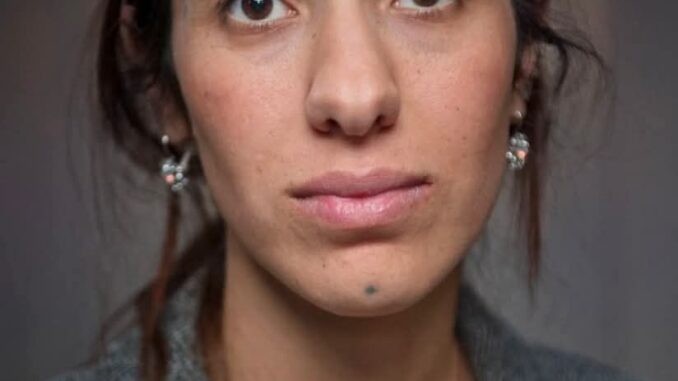
She was bought and sold seven times in three months. Then she stood before the United Nations. And she refused to remain silent.
August 3, 2014. Kocho, Iraq.
Nadia Murad was 21 years old when the trucks arrived. She was Yazidi—a religious minority in northern Iraq that ISIS had branded as “devil worshippers,” to be exterminated or enslaved. The fighters surrounded her village. The men and boys were separated from the women and girls. Her six brothers were taken away and executed at the edge of town. Her mother, deemed too old to be of use, was killed as well. Years later, Nadia would learn that she was likely buried alive.
The young women, including Nadia, were loaded onto a bus.
Destination: sexual slavery.
In Mosul, an ISIS stronghold, she was held with hundreds of other Yazidi women—some as young as nine years old. Fighters came, chose, and took them away. Nadia was bought by an ISIS judge, raped repeatedly, then sold to another. In three months, she was sold seven times. Beaten, burned with cigarettes, raped until she lost consciousness. She tried to escape. She was punished with a gang rape by six men. Then she was beaten so badly she could no longer walk.
In November 2014, she found an open door. She ran. A Muslim family, risking their own lives, hid her. After a clandestine journey, she reached a refugee camp. Then Germany.
She was free. She was alive. She had a choice.
Many survivors of rape—especially in cultures shaped by shame—choose silence. Nadia did not.
In December 2015, she spoke before the UN Security Council. She was 22 years old. She told every detail, without filters, without euphemisms.
“They took us as spoils of war. They raped us. They traded us like cattle. Girls as young as nine. Elderly women executed.”
Her testimony shook the world. Her face, her voice, her truth became impossible to ignore.
In 2016, the UN formally recognized the Yazidi genocide.
But Nadia did not stop. She met with leaders, testified before governments and parliaments, visited camps, searched for missing women. And she understood that testimony was not enough.
In 2018, she founded Nadia’s Initiative—an organization that rebuilds villages, schools, clinics, and water systems; that provides psychological and legal support to survivors; that documents crimes so they may one day be prosecuted.
That same year, she received the Nobel Peace Prize. She was 25 years old—the first Iraqi woman in history to receive it. The reason cited: her courage in speaking out and taking action.
During her speech in Oslo, she said:
“I beg you: make real the only prize I wish for—the liberation of all Yazidis and other minorities still held by ISIS.”
Nadia could have stopped. Withdrawn. Instead, she continues. She continues to speak.
Every word, every interview, every speech reopens a wound. But she continues. Because 10,000 Yazidis have been killed. 6,800 abducted. Because many mass graves have yet to be opened. Because justice has not yet reached those who turned children into slaves.
The world tends to forget. She does not.
Her voice remains. It echoes in courtrooms. It changes laws. It rebuilds villages.
And above all, it gives strength to other survivors—in Congo, in Syria, in Bosnia—women who, because of her, find the courage to speak. To raise their heads.
“I never wanted to be a symbol,” she said. “I wanted to go home with my family. But that’s no longer possible. So I will use my voice for those who cannot speak.”
Her courage does not erase the pain.
But it transforms it—into memory. Into justice. Into action.
She did not merely survive.
She refused to let survival be enough.
And that—that is power.
Leave a Reply