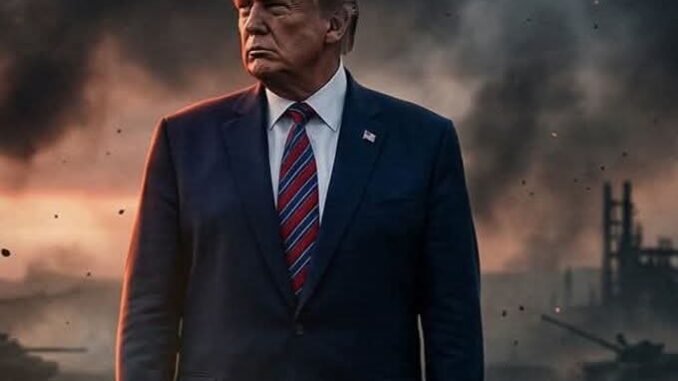
During his 2024 presidential campaign, Donald Trump promised Americans he would end wars not start new ones. He vowed to bring troops home, to silence the drums of conflict. Yet over the past year, he has ordered military strikes in seven different countries. Instead of retreating from battle, his appetite for confrontation appears to be growing alongside his hunger for political dominance.
Now, he has ordered a new strike against the Islamic Republic of Iran, coordinating with Israel, and declaring it will be far broader than the targeted bombing of nuclear facilities in June. But he launched this war without clearly explaining to the American people — or to the world — why it was necessary. He did not seek authorization from Congress, even though the Constitution grants it the exclusive power to declare war.
Instead, at 2:30 a.m. Eastern Time, shortly after the bombs began to fall, he released a video claiming Iran posed “imminent threats” and openly called for regime change. Delivering the case for war through a late-night recording is not leadership — it is evasion. His justifications remain deeply contested.
One of his stated objectives is dismantling Iran’s nuclear program — a goal many would consider noble. Yet in June, he declared that program “obliterated.” That claim contradicted U.S. intelligence assessments and now stands in tension with this new escalation. The inconsistency raises troubling questions about his commitment to truth when American lives are placed in harm’s way. Trust, once fractured, is not easily restored.
To be clear, Iran’s regime inspires little sympathy. Since the 1979 revolution, it has oppressed its own people, silenced dissent, executed political opponents, persecuted women and minorities, and fueled instability across the Middle East. Its leaders have chanted “death to America” while supporting militant groups and contributing to violence beyond their borders. The threat it poses is real — especially when paired with nuclear ambition.
Preventing Tehran from obtaining a nuclear weapon has long been a bipartisan American commitment. The consequences of allowing Iran to follow the path of North Korea would be severe. And there are arguments that acting now — while Iran faces internal weakness and regional setbacks — could carry lower costs than waiting.
Since the October 7, 2023 attacks, Israel has weakened Iranian-backed groups like Hamas and Hezbollah. Regional dynamics have shifted. Iran’s power no longer appears untouchable. Military action, though costly, can sometimes yield results.
But responsible leadership demands more than force — it demands clarity. A credible strategy. Congressional approval. International support. Honest communication about risks.
Instead, the president asks Americans to trust him blindly. He has not earned that trust.
He has dismissed allies, spread misinformation about past strikes, and failed to resolve crises in Ukraine, Gaza, and Venezuela. He has removed senior military leaders over questions of political loyalty. And when serious errors occur — such as Defense Secretary Pete Hegseth sharing sensitive strike details in an unsecured discussion — accountability seems absent.
War is not a campaign rally. It is not a midnight broadcast. It is not a slogan.
Iran still possesses significant military capabilities. While its medium-range missiles caused limited damage in Israel last year, it maintains shorter-range systems capable of striking regional neighbors. Even the president acknowledged in his video: “American heroes may lose their lives.”
That is a truth he should have spoken clearly to the nation — in a formal address, in daylight, before action began.
Members of Congress from both parties have sought to restrain him. Representatives Ro Khanna and Thomas Massie introduced a resolution to prevent unauthorized war with Iran. Senators Tim Kaine and Rand Paul have proposed similar measures. Their efforts reflect a constitutional principle: war powers do not belong to one individual.
History casts a long shadow. The regime-change wars in Iraq and Afghanistan toppled governments but deepened public skepticism and left lasting scars on service members and their families. Calls for regime change today demand sober explanation — not impulsive escalation.
Now that the operation has begun, hope centers first on the safety of American forces carrying it out — and on innocent Iranians who have suffered under repression for decades. War demands gravity, humility, and honesty.
And above all, it demands a president willing to treat it with the seriousness it deserves.
Leave a Reply