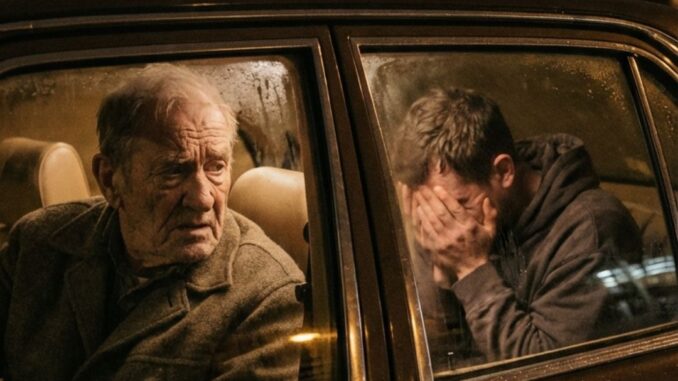
I canceled the ride in the app. He was sobbing in my backseat, but I refused to take him home to his children.
I didn’t even ask for the destination. I picked him up at the sliding glass doors of the county hospital. It was 2:00 AM on a Tuesday.
He got in, slammed the door of my sedan, and curled into a ball. He wasn’t just crying. He was making that sound—that low, animal noise that rips out of you when your entire world has just evaporated.
“Just drive,” he choked out. “Please. Just get me to the address.”
I looked in the rearview mirror. He was young. Maybe thirty. He was clutching a clear plastic bag with a woman’s purse and a pair of sneakers inside.
I knew that bag. I knew exactly what that bag meant.
I pulled away from the curb, but I didn’t follow the GPS. I turned off the radio.
“Rough night doesn’t cover it, does it?” I asked. My voice was quiet.
He gasped for air, rocking back and forth. “She’s gone. A blood clot. It was… it was so fast. She was just here.”
He hit the back of my seat with his fist. Not in anger, but in agony.
“I have to go home,” he whispered. “I have to tell our kids. They’re sleeping. They think Mom is just at the doctor.”
That’s when I pulled the car over.
We were three miles from his house, at that dark overlook near the reservoir. The city lights were just a blur in the distance.
I put the car in park and hit the ‘Cancel Ride’ button on my phone screen.
“What are you doing?” he asked, panic rising in his voice. “Why are we stopping?”
“Listen to me, son,” I said. I turned around to face him. I’m seventy-two years old. I’ve been driving this car since my retirement money ran thin, but I’ve been living life a lot longer than that.
“You cannot walk through that front door right now,” I told him. “Not like this.”
He stared at me, tears streaming down his face. “I want to see my kids.”
“I know,” I said. “And you will. But right now, you’re an open wound. If you walk in there and those babies wake up and see you shaking like this, that’s the image that will haunt them for the rest of their lives. You need a minute. You need to let the storm pass before you try to be the shelter.”
He collapsed back against the seat.
“I can’t do it,” he sobbed. “I can’t do this without her.”
“I know,” I said again. “But you’re going to.”
I opened my door. “I’m going to step outside and check my tires. You stay in here. You scream. You yell. You curse God. You let it all out in the back of this car so you don’t have to do it in front of a five-year-old.”
I got out. I shut the door.
I walked to the front of the hood and leaned against it. It was a cold night. I buttoned my jacket.
From inside the car, I could hear it. Muffled screams. The sound of a man breaking into a thousand pieces.
I stood there for twenty minutes. I watched the traffic go by on the highway below. I thought about my own wife, gone ten years now. I thought about the silence of my own house.
Eventually, the car went quiet.
I tapped on the glass. He nodded.
When I got back in, he looked exhausted. His eyes were red and swollen, but the shaking had stopped. He looked like a man who had survived a war and was ready to walk back into civilization.
“I’m ready,” he said. His voice was hoarse.
I drove him the rest of the way in silence. We pulled up to a nice suburban house with a basketball hoop in the driveway. The porch light was on.
He opened the door, then paused. He reached for his wallet. He pulled out a crumpled hundred-dollar bill.
“Take it,” he said. “Please. For the time. For… everything.”
I pushed his hand away.
“Put that back in your pocket,” I said firmly. “Order pizza for the kids tonight. And tomorrow night. Don’t worry about cooking. Just be there with them.”
He looked at me for a long second. Then he reached over the center console and grabbed my hand. He squeezed it so hard my knuckles popped.
“Thank you,” he whispered. “You gave me the space to fall apart so I could be a dad again.”
“Go on now,” I said.
I watched him walk to the door. He took a deep breath, wiped his face with his sleeve, and unlocked the house.
I waited until the lights went on inside before I put the car in gear.
We are so lonely in this country sometimes. We are so obsessed with being tough, with moving fast, with getting to the next destination. But sometimes, the most human thing you can do for a stranger is just park the car and stand in the cold, so they don’t have to be alone in the dark.
We’re all just walking each other home.
Leave a Reply