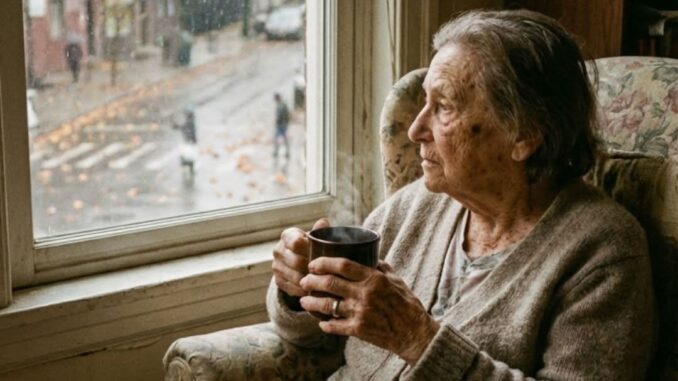
At 79, I live alone… and I finally feel free. When people find out I live by myself in this big old house, I see that immediate shift in their eyes. It’s a softness that tries to be kind but often looks a lot like pity. Then they ask, lowering their voices as if they’re afraid of breaking me:
“Don’t you get bored?”
“Doesn’t the house feel too empty at night?”
I smile.
Not because I don’t understand their worry, but because they haven’t lived long enough to know one simple truth: living alone doesn’t mean being alone in the world.
My name is Margaret, I’m 79 years old, and I live in my own home. It’s a colonial on a quiet street that used to be filled with noise, speed, screen doors slamming, and laughter echoing down the hallway. There were Thanksgiving dinners where we all talked over each other, little feet running across the hardwood floors, toys abandoned under the coffee table, and nights where we ate lukewarm casserole because everyone got home from practice or work at different times.
And there were also those nights I didn’t sleep. Not because of a sad movie, no. But because of life. Because of the bills, the worries, the mental math you do in the dark, the things you don’t say so you don’t add more weight to someone else’s shoulders. I’ve been through the comfortable years and the years where we had to tighten our belts. I’ve known love, yes, but I’ve also known exhaustion.
I was a wife. I was a mother. I was that woman who holds everything together, quietly, behind the scenes. The one who remembered the dental appointments, the refills for the prescriptions, the grocery lists, the birthdays, the logistics to keep the machine running. I lived for others for a long time. A very long time.
Then, my husband passed away.
It’s not an easy sentence to say. It drops like a stone in water. It ripples, over and over. After the funeral, after the neighbors stopped bringing food, the silence scared me. A silence that wasn’t just in the rooms, but in my own heart, which was so used to beating in time with someone else’s presence.
And of course, there was the advice, the well-meaning lectures, the serious looks from family and friends:
“You should sell and move closer to the kids.”
“At your age, you really shouldn’t be maintaining a place like this.”
“It’s safer if you’re in a community with assistance.”
I don’t blame them. It was love, in their own anxious American way. But behind that concern was an idea that gnawed at me for a long time: as if a woman of my age must inevitably be “managed.” As if quiet was a danger. As if peace was suspicious.
I even wondered if I was being selfish.
Selfish for wanting the silence.
Selfish for loving this tranquility.
Selfish for not feeling the need to be surrounded or productive 24/7.
And then one morning, a standard Tuesday, without any fanfare or grand speech… everything became clear.
I was sitting in the sunroom, a cup of coffee in my hands. Outside, the sky was that pale gray you see in late autumn. I watched the neighborhood: a woman rushing to her car with a travel mug, a delivery truck idling down the street, leaves drifting across the driveway. Nothing spectacular. Just life, moving fast.
And I understood, all at once:
I wasn’t abandoned.
I had been given back to myself.
It’s a phrase that might sound dramatic. But the truth of it is found in the tiny things, and that is exactly what makes it beautiful.
I eat when I’m hungry. I don’t ask anyone if they want something, if the restaurant choice is okay, or if we should wait ten minutes. I make what I crave—sometimes just a grilled cheese sandwich, sometimes a full roast as if I were hosting a party, just for the pleasure of treating myself right.
I sleep when my body tells me to. Sometimes I stay in bed a little longer on a rainy morning. Not out of depression. Out of gentleness. Because I can.
I pass entire days without speaking to a soul. And yet, my heart isn’t cold. The silence isn’t a punishment anymore. It has become a quiet companion, like an old friend who sits on the porch with me without asking questions, without judging, without demanding anything.
I read. I watch old movies. I take walks around the block. I tend to my garden. I observe the world. Sometimes I scroll through the news on my tablet, I see faces from the past, I see that some are gone, and others are still smiling in Florida or Arizona. Then I exhale slowly, and I think: I am still here. I am sharp. I am at peace.
My children have their own busy lives—careers, mortgages, kids of their own. They call, they visit on holidays, they check in. And I am grateful for them. But it is not their job to fill my days. I raised them to be independent. And today, they let me be independent, too. It’s not distance; it’s respect.
I am not happy all the time. No one is.
There are days when the sadness comes back, naturally, like a visitor knocking at the door. It reminds me of what won’t return, it tightens my throat a little, it brings back memories of Christmas past. I let it pass through. I don’t fight it. I don’t make it into an enemy.
But what stays with me the longest isn’t the loneliness.
It is the peace.
The peace of knowing I took care of others, enough.
The peace of knowing I gave, a lot.
The peace of no longer having to prove I am useful by forgetting myself.
At 79, I have earned a precious right: the right to take care of myself, exactly how I see fit.
I live alone, but I am not lost.
I don’t make noise.
I’m no longer running after everything.
I breathe.
So when people ask me, still, with that worried look: “But Margaret, in the evening… aren’t you afraid?”
I simply answer:
“No. The silence isn’t my enemy.
It’s my home.
And that is where I finally feel free.”
Leave a Reply