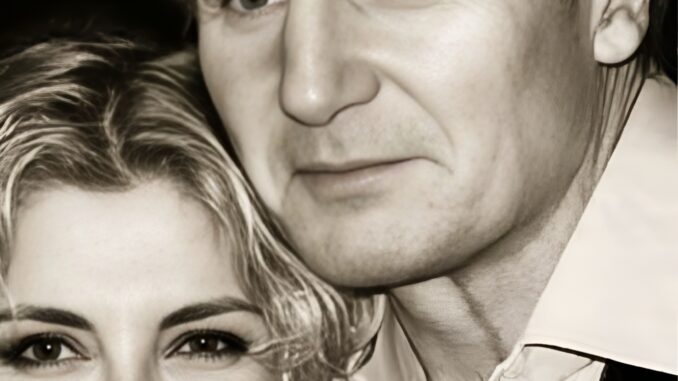
She fell on a beginner ski slope… and laughed it off.
Two days later, he authorized the removal of the machines keeping her alive.
She was 45 years old. They had been married for 15 years.
March 16, 2009 — Mont-Tremblant ski resort, Quebec
Natasha Richardson was taking a beginner ski lesson. No difficult runs—just gentle slopes and basic techniques.
Then she fell.
Nothing dramatic. The kind of fall that happens to anyone who skis. She got up, brushed off the snow, and laughed.
The instructor asked if she was okay.
She said yes.
No visible injuries. Just a little embarrassment.
An hour later, back at the hotel, she began complaining of a severe headache.
That night, an ambulance arrived.
The next day, Natasha was brain-dead.
The cause was an epidural hematoma—bleeding between the skull and the brain, with a cruel characteristic: at first, people seem fine. They talk. They laugh. They say they’re okay.
This is known as the lucid interval.
Then the blood builds up. Pressure rises. And everything collapses.
That is exactly what happened to Natasha.
Meanwhile, her husband Liam Neeson was working in Toronto when he received the call. He rushed to Montreal, where Natasha had been airlifted by helicopter. The doctors’ verdict was devastating: his wife was brain-dead.
The woman he had loved for fifteen years, the mother of their two sons, was gone.
Only machines were keeping her body functioning.
Liam Neeson has played warriors, spies, and heroes in dozens of films.
But nothing had prepared him for the decision he had to make in that hospital room.
Natasha was an organ donor. She had clearly expressed her wishes: if anything ever happened to her, she wanted her organs to save other lives.
So Liam made the hardest decision of his life. He authorized the withdrawal of life support so her organs could help others live.
Before that, he brought their sons—Micheál (13) and Daniel (12)—to say goodbye to their mother.
Imagine being thirteen.
Two days earlier, your mother was fine.
Now you are in a hospital room, holding her for the last time.
Liam has spoken of those moments only rarely, and every time his voice breaks:
“She was already gone, but I kept talking to her.
I told her I loved her, that the boys loved her, that we would be okay…
even though I didn’t know if it was true.”
On March 18, 2009, Natasha Richardson was taken off life support.
Her organs saved multiple lives—people who lived because of her.
The funeral was held on March 22 in New York State.
Liam Neeson, wearing sunglasses that couldn’t hide the devastation, carried his wife’s coffin into the small church. Friends described him as “completely silent, tears streaming down his face,” trembling under the weight of his grief.
It was Liam Neeson—the man known for his powerful voice and commanding presence—reduced to a grieving widower, barely able to stand.
After the funeral, Neeson all but disappeared from public life.
No interviews. No red carpets. No premieres.
He retreated with his sons, away from the spotlight.
The world moved on.
But for Liam—and for those boys—time stopped on March 18, 2009.
When he finally spoke publicly about Natasha’s death—months later, years later—his words were careful, measured, still deeply aching:
“Grief comes in waves.
You think you’ve learned how to swim…
and then it pulls you under again.”
He spoke of random triggers: a song they loved, something that would have made her laugh, the empty space beside him in bed.
“She was my anchor,” he said quietly.
“My laughter. The light in every dark room.”
Natasha Richardson was born into an acting dynasty—the Redgrave family—and built a respected career of her own.
But to Liam, she was just Tash.
His partner. His love.
They met in 1993 while performing together in a stage adaptation of Anna Christie.
They married in 1994.
They deliberately chose a quiet life, far from Hollywood chaos, raising their sons in rural New York.
Their relationship was known for being genuine, stable, deeply affectionate. They didn’t chase fame. Family came first.
Then she fell on a beginner ski slope…
and everything ended.
In the years after Natasha’s death, Liam slowly returned to work. Not out of desire, but because routine helped him survive—acting gave him structure when everything else felt meaningless.
He spoke openly about therapy, about learning to be a single father, about explaining to his sons what it means to lose someone you love.
He has also spoken about the ways Natasha is still with him:
“I still find her notes around the house.
Little messages she left.
I keep every single one.”
Those close to him say he still wears his wedding ring.
Not as worship of the past, but as a symbol of a love that doesn’t end just because someone dies.
He never remarried.
He never had public relationships.
When asked if he would ever love again, he answered honestly:
“Natasha was that for me.”
It isn’t tragic or morbid. For some people, it’s simply the truth:
when someone becomes so central to who you are, imagining life with someone else feels impossible.
Today, Liam Neeson is 72 years old.
His sons are grown—both have pursued acting.
Micheál even adopted his mother’s last name, Richardson.
When Liam speaks of Natasha now, fifteen years later, his voice still changes.
The grief is no longer an open wound, but it has never left. It has become part of who he is.
“She gave me so much joy,” he said recently with a gentle smile.
“I miss her every day.”
That smile—sad, genuine—reveals something profound about grief:
it doesn’t mean you stop living.
It means you live with absence woven into every moment.
Natasha Richardson fell on a beginner slope and laughed it off.
Forty-eight hours later, she was brain-dead.
Liam Neeson held her hand, said goodbye, and has spent fifteen years choosing—every single day—to go on.
He played heroes his entire life on screen.
But the real heroism was this:
waking up every morning after losing your anchor…
and choosing to live anyway.
This is not a scene from a movie.
This is life—beautiful, fragile, and profoundly unfair.
And Liam Neeson survived her.
Still.
Leave a Reply