I was thirty-four when my world split cleanly in two.
One moment, I was still a wife—texting David ridiculous grocery lists and laughing at the way he insisted our baby would love classical music because he played it in the car. The next, I was standing in a hospital hallway with fluorescent lights buzzing above my head, listening to a doctor say the kind of sentence that doesn’t belong in real life.
David didn’t make it.
They told me it was an accident. A slick patch of road. A wrong second at the wrong time. The details blurred together, mercifully vague, like my mind refused to let them land. I was six months pregnant, and every time the baby kicked, it felt like my body was asking me to stay alive even when my heart didn’t know how.
In the weeks after the funeral, people brought casseroles, said they were “here if I needed anything,” and then slowly returned to their own lives. Grief doesn’t look dramatic most days. It looks like forgetting to eat. It looks like standing in the laundry aisle and suddenly crying into a pile of towels. It looks like staring at David’s shoes in the closet because you can’t quite accept they’ll never move again.

By the time Ethan arrived, I was hollowed out and running on instinct. My beautiful, healthy boy came into the world with a furious set of lungs and a stubborn little chin that made my mother smile through tears when she met him on video call.
“David’s chin,” she whispered.
I should’ve felt relief, joy, some bright new beginning.
Instead, I felt terrified.
Bills kept coming. My savings vanished. The maternity leave I’d planned was suddenly a cliff. I applied for assistance with hands that shook, ashamed even though I knew I shouldn’t be. I learned what it was like to watch the balance in my account hover near zero and think, How can love be this powerful and still not keep the lights on?
My mom lived states away. We’d never been overly sentimental, but she’d started calling every day after David died. Her voice stayed steady, even when mine cracked.
“Come home,” she said one night, firm as a seatbelt. “Let me help you.”
Home. The word tasted like safety. Like warm soup and someone else holding the baby so I could shower without sprinting. Like a night of sleep where I wasn’t waking every forty minutes in panic, listening to make sure Ethan was breathing.
I looked at my bank app again. There was just enough for one economy ticket.
So I used my last bit of money to buy it.
The day of the flight, Ethan seemed determined to prove he was built for drama. He cried in the car. He cried in the check-in line. He cried while the TSA agent searched my bag for the third time because my hands were so unsteady I kept forgetting to empty the side pockets.
By the time we boarded, my nerves were stretched so tight I felt like one more sharp word might snap me in half.
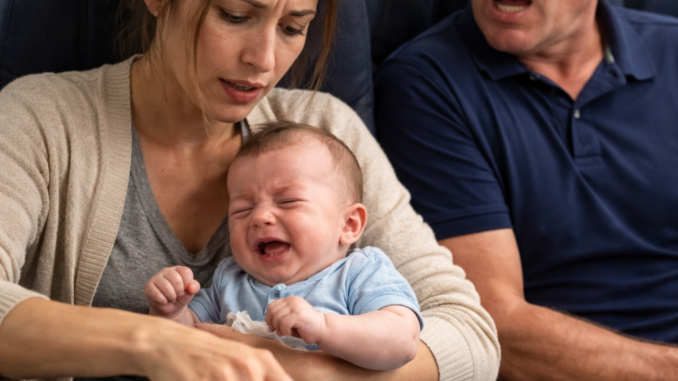
Ethan started crying as soon as we found our seats.
I bounced him. I shushed him. I whispered, “It’s okay, baby, it’s okay,” as if my voice could build a soft wall between us and the rest of the plane.
It couldn’t.
People sighed. A woman across the aisle pressed earbuds in aggressively and glanced at me like I’d brought a live siren on board. A teenager in front of me turned around and mouthed something to his friend with a smirk.
Then the man sitting beside me leaned over.
He was maybe late forties, with a crisp polo shirt and a face that looked permanently irritated. He had the kind of voice that didn’t ask, it ordered.
“SHUT UP, BABY!” he snapped, loud enough that heads turned. “DID I PAY FOR YOUR SCREAMING BABY TO FLY?!”
Heat rushed up my neck. My hands tightened around Ethan’s little body, not hard, just instinctively protective. I stared at the seatback in front of me like it might rescue me.
“I’m sorry,” I managed. “He’s… he’s tired. I’m trying—”
“Trying?” he scoffed. “That’s not trying. That’s letting him ruin everyone’s flight.”
Ethan’s face scrunched even more, and the crying climbed into a frantic pitch. His little fists waved. His cheeks turned blotchy.

I reached into the diaper bag with shaking fingers and pulled out wipes and a fresh diaper. Sometimes a change helped. Sometimes it didn’t. But I had to do something—anything—before the whole plane decided I was the enemy.
As I attempted to quickly change my baby in my cramped seat, Ethan abruptly stopped crying.
For one beautiful second, I thought I’d done it. I thought we were safe.
Then Ethan giggled.
It was the loud, delighted laugh of a baby who had discovered the hilarious thrill of kicking his feet in the open air.
The man beside me recoiled like I’d thrown something at him. His face twisted in disgust.
“OH MY GOD, THAT’S GROSS!!” he barked. “Go to the bathroom and sit there with your baby until he falls asleep! OR BETTER YET, STAY THERE FOR THE REST OF THE FLIGHT!”
A few people laughed—quick, nervous laughs, the kind people make when they don’t want to be the target next. Someone behind me muttered, “Finally,” as if I’d already moved.
My throat tightened so hard it hurt. Tears burned my eyes, but I forced them back. Crying would only make Ethan cry again, and then it would be worse. Everything could always get worse.
“I—okay,” I whispered. My voice came out thin and cracked.
My hands trembled as I gathered Ethan, the wipes, the diaper, trying not to drop anything. Ethan squirmed happily, unaware that his giggle had turned into a public crime.
I stood up, keeping my head down.
Each step toward the small hallway by the bathrooms felt like walking through a spotlight. I could feel eyes on my back, judging, measuring, deciding what kind of mother I was based on a few minutes they’d witnessed in a metal tube in the sky.
I was almost there—almost to the bathroom door—when a tall man in a dark suit stepped into my path.
Not a passenger suit. A real suit. Dark, perfectly fitted, the kind of crisp that suggested someone else had steamed it for him. He had neatly trimmed hair and calm eyes that didn’t dart around like the rest of us. He looked… anchored.
“Ma’am,” he said softly, like he was speaking to a person instead of a problem. “Follow me.”
I blinked at him, confused and instantly afraid I’d done something wrong. My heart stumbled. I tightened my hold on Ethan.
“I’m sorry,” I started, because apologies were all I’d been doing for months. “I’m going to the—”
“You don’t need to,” he interrupted gently. “You and your son shouldn’t be cramped in there.”
He gestured toward the front of the plane, where a curtain separated economy from the world I’d stopped believing I could access. A flight attendant stood nearby, watching him closely, as if waiting for his signal.
“Please,” he said again. Not a command. An offer.
I hesitated. My brain scrambled for explanations—maybe he thought I was lost, maybe he was a crew member, maybe—
The flight attendant met my eyes and nodded once, reassuring.
“It’s okay,” she whispered. “Come with us.”
My legs moved before my pride could argue. I followed the man past the curtain, into wider seats and softer lighting. The air itself seemed quieter. A couple of business-class passengers looked up, curious, but no one sneered. No one rolled their eyes.
The man stopped at an empty seat by the window, one of the bigger ones.
“Sit here,” he said. “We’ll get you some water. If you need anything for Ethan, just ask.”
My mouth opened, but no words came. My chest felt full, like I’d been holding my breath since the moment David died.
“Why?” I finally managed.
The man’s expression didn’t change much, but something kind flickered in his eyes.
“Because someone should,” he said simply.
I sat down, stunned. Ethan wriggled and then settled against my chest as if he’d been waiting for a calmer place. The flight attendant brought me water, and another brought a small warm cloth for my hands because she must have seen how I shook.
From my new seat, I could still see into economy through a slight gap in the curtain.
The man in the suit walked back there.
He took my old seat.
The bully looked at him with a grin, as if they were allies in a shared victory. He leaned back, loud enough for half the rows to hear.
“Finally,” he announced. “That woman with the baby is gone! MAN, YOU HAVE NO IDEA HOW HAPPY I AM!”
Some people chuckled again.

The man in the suit didn’t react. He buckled his seatbelt, then turned slightly, scanning the cabin like he was taking inventory.
Then he raised his voice—not angry, not harsh, just clear.
“Mr. Cooper?”
The bully’s grin faltered. He glanced up, annoyed at first, ready to snap at yet another person.
But then he really looked at the man in the suit.
And the color drained from his face.
His mouth opened, closed, then opened again.
“Uh… yes?” he croaked.
The man in the suit tilted his head slightly, as if confirming something.
“Thank you,” he said, calm as a judge. “I wanted to meet you.”
The bully swallowed. His eyes darted around, suddenly aware of every person listening.
“I—do I know you?” he tried, but his voice had lost its bite.
The man reached into his inner jacket pocket and pulled out a small badge and an ID card. He held it just long enough for Mr. Cooper to see—long enough for the man’s expression to collapse into pure panic.
“I’m James Alden,” the man said. “Director of Customer Experience and Compliance for this airline.”
A collective hush fell over the nearby rows. Even the people who’d laughed earlier went still.
Mr. Cooper’s face turned a blotchy shade of red.
“I—I didn’t—” he stammered. “I mean, I was just—”
“You were just loudly humiliating a grieving mother traveling alone with an infant,” Mr. Alden said, still even-toned. “You were encouraging her to isolate herself in a restroom for hours. You used language that violates the code of conduct you agreed to when you purchased your ticket.”
Mr. Cooper tried to laugh, but it came out weak and ugly.
“Come on. It’s not a big deal. People are too sensitive. That baby was—”
“That baby,” Mr. Alden cut in, “is a passenger. His mother is a passenger. They paid for this flight the same way you did. And they are entitled to basic human decency.”
Mr. Cooper’s eyes widened as the flight attendant approached with a tablet. Another crew member stood behind her, arms folded.
Mr. Alden nodded toward the tablet.
“Ms. Ramirez,” he said to the attendant, “please document this incident fully. Include witness statements from any passengers in rows fifteen through eighteen.”
Mr. Cooper’s head snapped around.
“Witness statements?” he squeaked. “You can’t—”
“Oh, we can,” the flight attendant said politely, and for the first time her smile looked like steel.
Mr. Cooper’s voice rose, desperate now.
“This is ridiculous! I fly this airline all the time! I’m a platinum member! I spend thousands—”
Mr. Alden leaned in just slightly, not threatening, but firm enough that Mr. Cooper’s words sputtered.
“Then you should understand,” he said, “that status is not permission to behave like this.”
Mr. Cooper’s hands curled into fists on his knees.
“So what? You’re going to kick me off midair?” he snapped, grasping for control.
“No,” Mr. Alden replied. “We’re going to do something far more inconvenient for you.”
He straightened, addressing him like a matter-of-fact professional.
“When we land, you’ll be met at the gate. Your loyalty status will be reviewed for conduct violations. Your return flight—if it’s with us—will be reassigned at the lowest available priority. And you’ll receive a formal notice regarding future travel restrictions pending investigation.”
Mr. Cooper stared at him like he’d been punched.
“You can’t do that,” he whispered.
Mr. Alden’s expression didn’t budge.
“I can,” he said. “And I will.”
Then, as if it mattered equally, he added, “You owe that mother an apology.”
Mr. Cooper jerked his gaze toward the front of the plane—toward me—toward the business-class curtain where I sat holding my son, frozen.
Every instinct in me screamed to disappear.
But something about the way Mr. Alden had spoken—entitled to basic human decency—made me lift my chin.
Mr. Cooper’s lips parted. Pride fought shame on his face. His eyes flicked to the watching passengers. He swallowed hard.
“I… apologize,” he said, the words forced out like splinters. “I shouldn’t have… said that.”
It wasn’t warm. It wasn’t kind. But it was there, spoken in front of everyone he’d tried to impress with cruelty.
Mr. Alden nodded once, like that was the minimum required to re-enter the world of civilized people.
“Thank you,” he said, then turned away.
As he walked back toward the front, the cabin slowly exhaled. A woman in economy leaned into the aisle and called quietly, “Good.”
Someone else murmured, “Finally.”

This time, it wasn’t about me.
Mr. Alden stopped at the curtain. He glanced back at me, his voice dropping so only I could hear.
“Ma’am,” he said. “I’m sorry for your loss. And for what you experienced back there.”
My eyes stung. I gripped the cup of water with both hands to stop them from shaking.
“Thank you,” I whispered. “I didn’t… I didn’t know people like you existed.”
His face softened.
“We should exist more often,” he said.
Then he stepped aside and let the flight attendant check on me again. She brought Ethan a small packet of baby-safe snacks—probably meant for toddlers, but the gesture made my throat tighten anyway.
For the rest of the flight, something shifted.
Not magically. Not like grief vanished or bills stopped. But the world didn’t feel quite as hostile.
A woman across the aisle in business class smiled at Ethan when he babbled. A man offered to lift my bag when we landed. Small things—tiny, ordinary kindnesses that felt enormous after months of survival.
When we touched down, I held Ethan against my shoulder and watched passengers file out. In the aisle, Mr. Cooper stood stiffly as two airline representatives waited near the exit. His face was pale now, his eyes fixed on the floor.
He didn’t look powerful anymore.
He looked like someone facing consequences he couldn’t bully his way out of.
As I stepped into the jet bridge, I felt the weight of the last year press against my ribs—the funeral, the sleepless nights, the welfare paperwork, the loneliness so sharp it could cut. I still carried all of it.
But I also carried something new.
A reminder that I wasn’t invisible. That cruelty wasn’t the only thing loud enough to fill a room. That sometimes, someone calm and steady could interrupt the ugliness and say, No. Not here.
In the arrivals area, I spotted my mother before she spotted me. Her hair had more gray than I remembered. She stood on tiptoes, scanning faces, anxious and hopeful all at once.
When she saw Ethan, she pressed a hand to her mouth. When she saw me, her eyes filled.
I walked faster, and she met me halfway, wrapping us both in her arms like she could seal the cracks in my life with sheer force.
“Baby,” she whispered into my hair. “You’re home.”
Ethan sighed against her shoulder, completely at peace, as if he understood.
And for the first time in a long time, I let myself believe that maybe my life hadn’t ended.
Maybe it had simply been rerouted.
And maybe—just maybe—there were still people in this world who would stand up, call out the cruelty, and make room for a mother and her child to breathe.
Leave a Reply